Insights · Pricing
The real cost of a sitewide discount
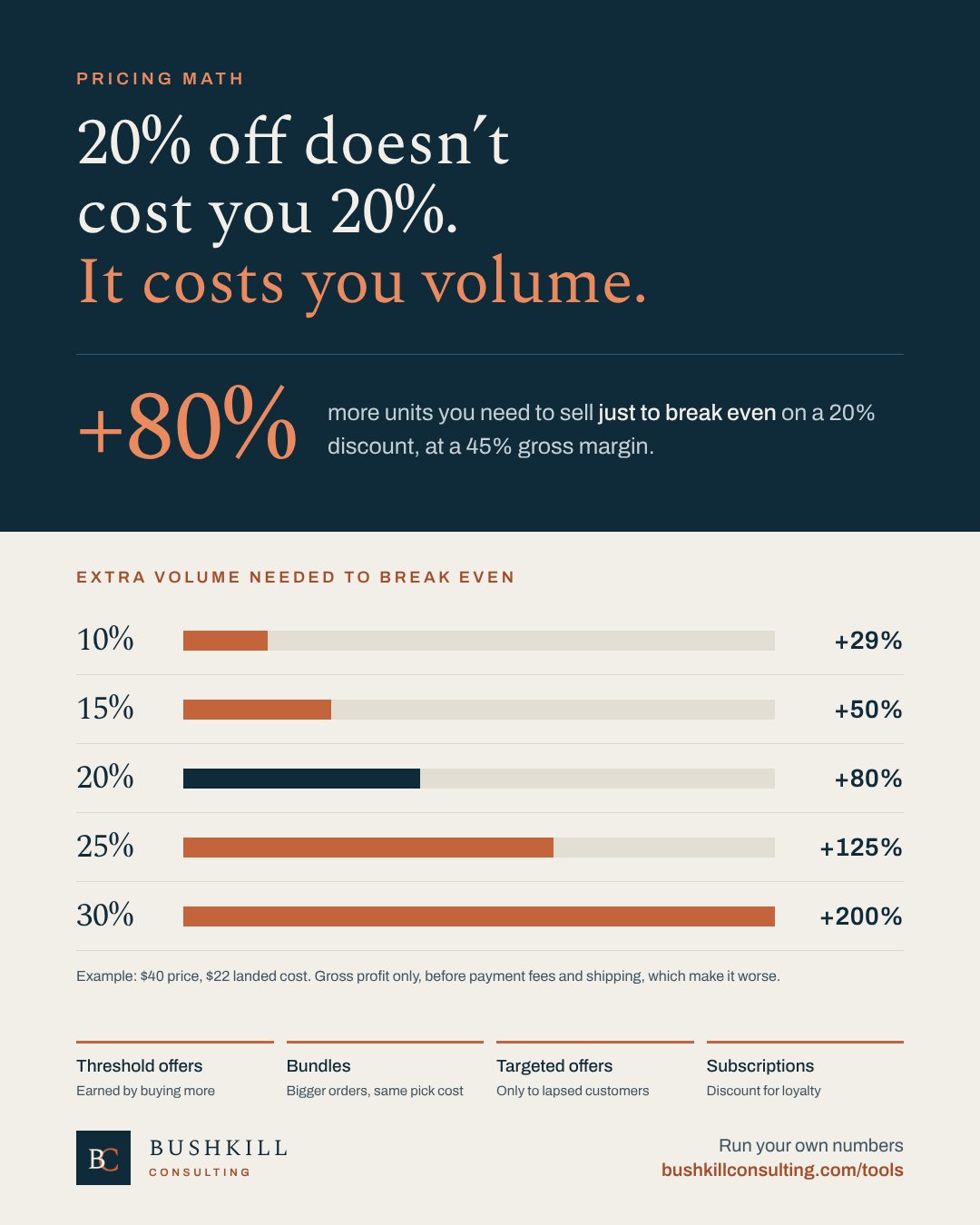
Most promotional calendars are built backwards. Somebody decides the business needs a boost this month, a percentage gets picked because it sounds like enough, and the banner goes up. The question that should come first, how much more we have to sell for this to be worth it, usually never gets asked.
It is worth asking, because the answer is almost always bigger than people expect.
The arithmetic
Take a product that sells for $40 and costs you $22 landed. That leaves $18 of gross profit, a 45% margin. Healthy enough.
Now run it at 20% off. The price drops to $32. Your cost doesn't move, so profit per unit falls to $10. You did not give away 20% of your profit. You gave away $8 of $18, which is 44% of it.
To earn the same gross profit you earned before the sale, you now need to sell 80% more units. If you normally move 500 a month, the promotion has to sell 900 just to break even. Not to grow. To stand still.
The lower your margin, the worse this gets. At a 30% margin, a 20% discount needs you to triple your volume.
And that is the generous version. It ignores payment fees, which are charged on the full transaction. It ignores shipping, which often costs you the same at any price. Most of all, it ignores the customers who were going to buy that week anyway and just got a discount for showing up on schedule.
The habit it builds
The arithmetic is only half the problem. Run sitewide promotions often enough and your customers learn the calendar. They wait. Full-price sales thin out between events, which makes the next promotion feel more necessary, which teaches them to wait a little longer.
I have been inside a business caught in that loop. Ending sitewide discounting there was one of the two ways I have recovered more than 400 basis points of commercial margin. It is not a comfortable decision to make, because the sales comparisons against last year's promotion weeks look worse before the margin line looks better. That is exactly why so many businesses never make it.
Need a hand with this? I help consumer brands rebuild their promotional calendar around margin, not habit. Let’s talk →
What to run instead
Stopping blanket discounts doesn't mean stopping promotions. It means making every offer ask the customer for something in return.
Threshold offers
Free shipping or a free gift above a set order value. Set the threshold a little above your average order and most carts are close enough to want to cross it. The customer earns the offer by buying more, which is the whole point.
Bundles
A saving on three or four items bought together. Fifteen percent off a four-item order is worth far more to you than fifteen percent off one item, because your picking, packing and shipping cost is spread across the bigger order.
Targeted offers
Save the deeper discounts for customers who have lapsed: no order in six months, say. That way the offer goes to people who need a reason to come back, instead of to people who were already on their way.
Subscriptions
A modest standing discount on the products people reorder anyway, coffee or supplements or cleaning supplies, in exchange for predictable demand. Predictable demand is worth real money when you are planning inventory.
Run your own numbers
I built a discount break-even calculator that does this arithmetic for your price, cost and volume. It takes about a minute. If the result is uncomfortable, that is usually a good sign you have found some margin to recover.
You can also see all four of the alternatives above working together in the Saltmarsh demo store. Turn on "Show the thinking" to see why each one is there.
Want a second read on your promotions?
Send me last year's promotional calendar and your margins. I will tell you which ones I think earned their keep.