Insights · Promotions
Black Friday started on October 25
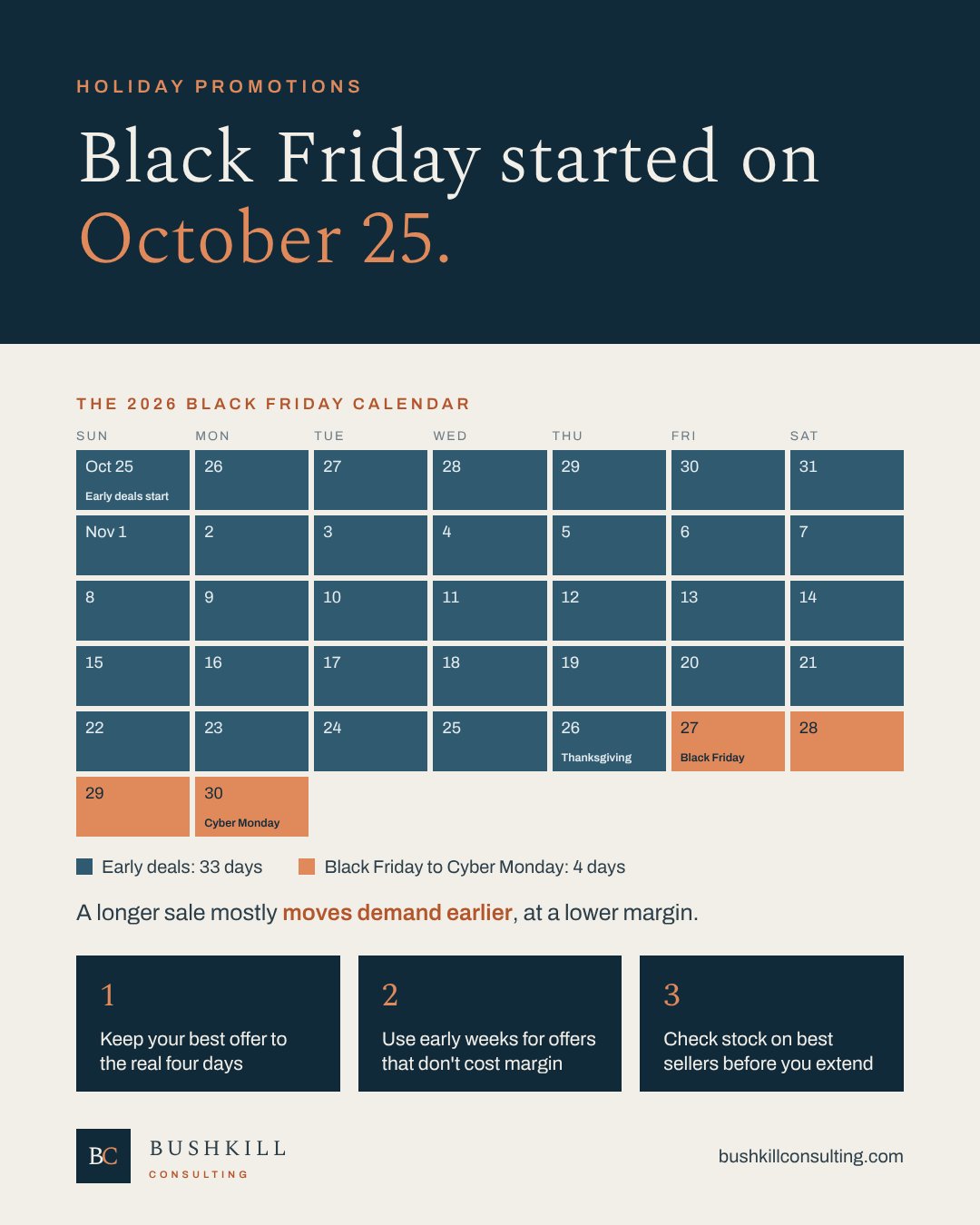
This year the first "early Black Friday" deals showed up on October 25. That was the day Ulta started weekly early Black Friday discounts of up to 50% off. Alo started a 30% sale the next day. Gap, Old Navy, Walmart and Target have all run early Black Friday sales since. Black Friday itself is November 27.
Count from that first sale to Cyber Monday and you get five weeks of Black Friday. The biggest retailers can carry a promotion that long. They have the traffic, the buying power and the vendor support to make it work. Most smaller consumer brands don't, and plenty of them follow along anyway because being the only store at full price feels risky.
A longer sale mostly moves demand
A promotion pays for itself when it brings in sales you would not otherwise have had. Stretching it out rarely does more of that. What it does is move sales you were already going to get. The customer who would have bought from you in the last week of November buys in the first week instead, at the discount.
Circana, which tracks point-of-sale data for consumer brands, puts it plainly: “Pull-forward is not new money. It is the same money, moved earlier in time, usually at a thinner margin.” Adobe now calls October deals an industrywide event that pulls a spike of holiday shopping into October.
The sales report looks fine. Five weeks of promotion, five weeks of orders. What it doesn't show is the full-price business those weeks used to carry, or the margin you gave up on every order that would have come in anyway. Circana's example: a promotion that lifts sales 12% while it runs can add nothing for the year once the slump after it is counted.
I wrote earlier about the real cost of a sitewide discount. At a 45% gross margin, 20% off means selling 80% more units just to earn the same gross profit. Run that discount for five weeks instead of four days and you need that lift across a month of orders, mostly from customers who were not going anywhere.
It also assumes the money is still there when Black Friday arrives. In a Deloitte survey of 408 Chicago-area shoppers cited by the Sun-Times, about a quarter said their holiday budget was already spent by the end of October. A customer who spent theirs on an early sale is not coming back on the 27th.
Need a hand with this? I help consumer brands build their promotional calendar around margin, not habit. Let’s talk →
What I would do instead
Keep your best offer short
Black Friday through Cyber Monday is four days. A real deadline gives people a reason to buy now, and it puts your deepest discount on the days when traffic is highest anyway. Shoppers know when those days are. Adobe expects online discounts to average about 14% in early November and peak near 30% in the five days from Thanksgiving to Cyber Monday, which it forecasts at about 17% of the season's online spending.
Use the early weeks for offers that don't cost margin
Gift guides, bundles, a free shipping threshold and early access for your email list all give people a reason to shop in early November without marking down the whole store. The sitewide discount piece covers how each of these works.
Price the extra weeks before you add them
Pull what those same days sold at full price last year. That is what the extra weeks of discount are really costing you. Put it next to what you expect the promotion to add and see which number is bigger. The discount break-even calculator will do the arithmetic for your price, cost and volume.
Check stock on your best sellers
A long promotion can sell through your best items before the busiest days arrive. A stockout in the middle of the season also distorts the sales history you will plan next year from, which I wrote about in your sales history only counts the days you had it.
If your sale is already running, it is not too late. Pull last year's numbers for the next two weeks and decide whether the discount really needs to stay on until Thanksgiving.
Sources: retailer dates, discounts and the Deloitte survey are from the Chicago Sun-Times, “It’s true: Black Friday deals are starting even earlier than previous years,” November 14, 2026. Pull-forward findings are from Circana, “How to Tell If a Promotion Drove Real Growth,” July 10, 2026. Discount and Cyber Week forecasts are from Adobe’s 2026 holiday forecast, as reported by Retail TouchPoints on September 29, 2026.
Planning next year's promotions?
Send me this year's holiday calendar and your margins. I will give you a second read on what earned its keep before you plan the next one.